Burmeister, D.; Tran, H. A.; Müller, J.; Guerrini, M.; Cocchi, C.; Plaickner J.; Kochovski, Z.: List-Kratochvil, E.; Bojdys,* M. J. Angew. Chem. Int. Ed. 2021. DOI: 10.1002/anie.202111749 [OPEN ACCESS]
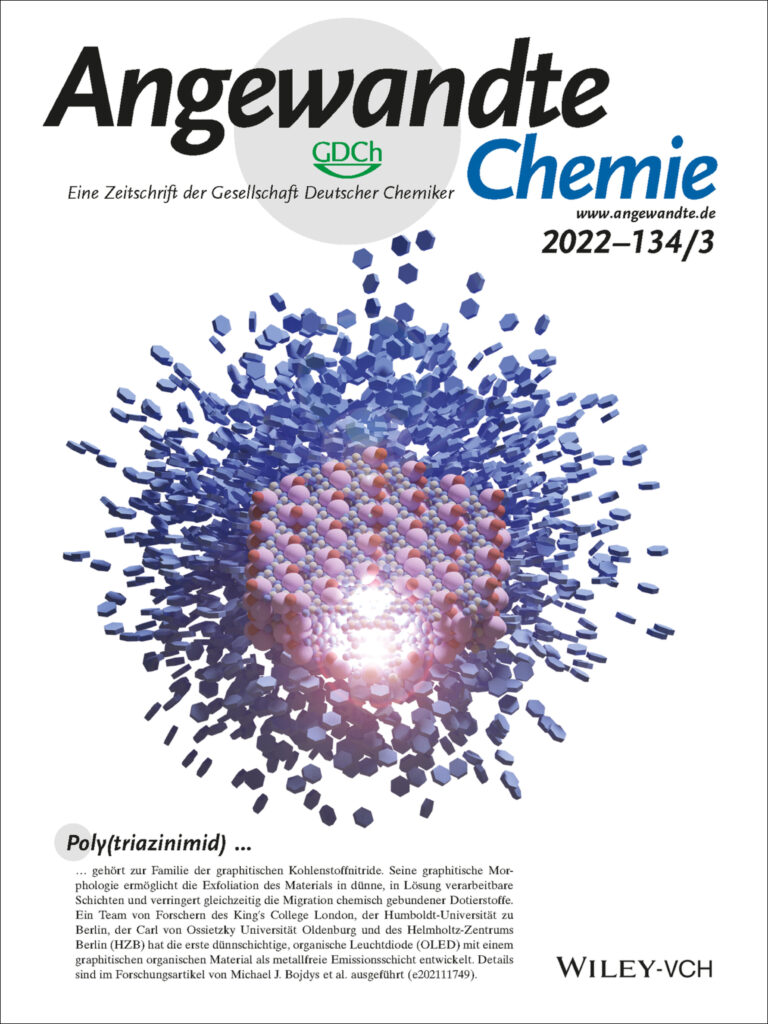

Burmeister, D.; Tran, H. A.; Müller, J.; Guerrini, M.; Cocchi, C.; Plaickner J.; Kochovski, Z.: List-Kratochvil, E.; Bojdys,* M. J. Angew. Chem. Int. Ed. 2021. DOI: 10.1002/anie.202111749 [OPEN ACCESS]
Burmeister, D.; Tran, H. A.; Müller, J.; Guerrini, M.; Cocchi, C.; Plaickner J.; Kochovski, Z.: List-Kratochvil, E.; Bojdys,* M. J. Angew. Chem. Int. Ed. 2021. DOI: 10.1002/anie.202111749 [OPEN ACCESS]
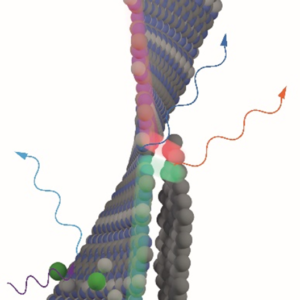 Crystalline semiconducting carbon nitrides are chemically and physically resilient, consist of earth abundant elements, and can be exfoliated into 2D atomically thin layers. In particular, poly(triazine imide) (PTI) is a highly crystalline semiconductor, and though no techniques exist to date that enable synthesis of macroscopic monolayers of PTI, it is possible to study it in thin layer device applications that are compatible with its polycrystalline, nanoscale morphology. In our study, we find that the by-product of conventional PTI synthesis is a C-C carbon rich phase that is detrimental for charge transport and photoluminescence. An optimised synthetic protocol yields a PTI material with an increased quantum yield, enabled photocurrent and electroluminescence. In addition, we report that protonation of the PTI structure happens preferentially at the pyridinic nitrogen atoms of the triazine (C3N3) rings, is accompanied by exfoliation of PTI layers, and contributes to increases in quantum yield and exciton lifetimes. This study describes structure-property relationships in PTI that link (i) the nature of defects, their formation, and how to avoid them with (ii) the optical and electronic performance of PTI. On the basis of our findings, we create an OLED prototype with PTI as the active, metal-free material, and we lay the foundations for device integration of solution-processable graphitic carbon nitride dispersions in semiconductor devices.
The Patent “Kathode und Verfahren zu ihrer Herstellung” (Cathode and process for its manufacture) has been filed as DE102021124299.1 – we’re looking forward to develop and commercialize this technology with our upcoming startup ElectMATs.
Kulkarni, R.; Huang, J.; Trunk, M.; Burmeister, D.; Amsalem, P.; Müller, J.; Martin, A.; Koch, N.; Kass, D.; Bojdys,* M. J. Chem. Sci. 2021. DOI: 10.1039/D1SC03390E [OPEN ACCESS]
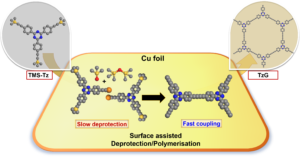 Graphdiyne polymers have interesting electronic properties due to their π-conjugated structure and modular composition. Most of the known synthetic pathways for graphdiyne polymers yield amorphous solids because the irreversible formation of carbon-carbon bonds proceeds under kinetic control and because of defects introduced by the inherent chemical lability of terminal alkyne bonds in the monomers. Here, we present a one-pot surface-assisted deprotection/polymerisation protocol for the synthesis of crystalline graphdiynes over a copper surface starting with stable trimethylsilylated alkyne monomers. In comparison to conventional polymerisation protocols, our method yields large-area crystalline thin graphdiyne films and, at the same time, minimises detrimental effects on the monomers like oxidation or cyclotrimerisation side reactions typically associated with terminal alkynes. A detailed study of the reaction mechanism reveals that the deprotection and polymerisation of the monomer is promoted by Cu(II) oxide/hydroxide species on the as-received copper surface. These findings pave the way for the scalable synthesis of crystalline graphdiyne-based materials as cohesive thin films.
Burmeister, D.; Trunk, M. G.; Bojdys,* M. J. Chem. Soc. Rev. 2021. DOI: 10.1039/d1cs00497b [OPEN ACCESS]
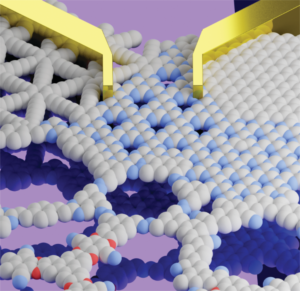 Metal-free 2D covalent organic materials transport charges along and in-between π-conjugated layers. Here, we look at the prospects of graphitic carbon nitrides and covalent organic frameworks as 2D semiconductors “beyond graphene and silicon”.
Kochergin, Y. S.; Beladi-Mousavi, S. M.; Kulkarni, R.; Khezri, B.; Lyu, P.; Schmidt, J.; Bojdys, M. J., Pumera,* M. J. Mater. Chem. A 2021, 9, 7162-7171. DOI: 10.1039/D0TA11820F [OPEN ACCESS]
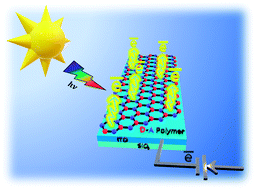 Conventional photoelectrocatalysts composed of precious metals and inorganic elements have limited synthetic design, hence, hampered modularity of their photophysical properties. Here, we demonstrate a scalable, one-pot synthetic approach to grow organic polymer films on the surface of the conventional copper plate under mild conditions. Molecular precursors, containing electron-rich thiophene and electron-deficient triazine-rings, were combined into a donor–acceptor π-conjugated polymer with a broad visible light adsorption range due to a narrow bandgap of 1.42 eV. The strong charge push–pull effect enabled the fabricated donor–acceptor material to have a marked activity as an electrode in a photoelectrochemical cell, reaching anodic photocurrent density of 6.8 μA cm−2 (at 0.6 V vs. Ag/AgCl, pH 7). This value is 3 times higher than that of the model donor–donor thiophene-only-based polymer and twice as high as that of the analogue synthesized in bulk using the heterogenous CuCl catalyst. In addition, the fabricated photoanode showed a 2-fold increase in the photoelectrocatalytic oxygen evolution from water upon simulated sunlight irradiation with the photocurrent density up to 4.8 mA cm−2 (at 1.0 V vs. Ag/AgCl, pH 14). The proposed engineering strategy opens new pathways toward the fabrication of efficient organic “green” materials for photoelectrocatalytic solar energy conversion.

If we did not feel the need for dialogue, the need for exchanging ideas, then we would be living in a global dictatorship of a selected few authoritative opinions. In June 2020, a team of talented, outspoken, diverse scientists from more than 30 institutions world-wide came together to prepare a joint, positive, forward-looking declaration of what “home” in science should look like, namely: colourful, exciting, and excellent.
Our authors spontaneously linked up on social media and by real-time communication into functional, ad-hoc teams to write, to brain-storm and to review this work. What drove this unique cooperation was the belief, that the most diverse pool of opinions and ideas will ultimately yield uniquely insightful and better results. Having witnessed this process first-hand, I am looking forward to the future of science that our authors envision.
This article “A diverse view of science to catalyse change” is co-published in the following journals: Nature Chemistry [DOI: 10.1038/s41557-020-0529-x], Chemical Science [DOI: 10.1039/D0SC90150D], Journal of the American Chemical Society [DOI: 10.1021/jacs.0c07877], Angewandte Chemie International Edition [DOI: 10.1002/anie.202009834], Canadian Journal of Chemistry [DOI: 10.1139/cjc-2020-0323], and Croatica Chemica Acta [DOI: 10.5562/diversity2020]. The accompanying community blog “Diverse Views in Science” is accessible via: https://chemistrycommunity.nature.com/channels/diverse-views-in-science
The World Economic Forum Agenda post is available on: https://www.weforum.org/agenda/2020/08/science-stem-support-inclusion-diversity-equality
Kochergin, Y. S.; Villa, K.; Kulkarni, R.; Novotný, F.; Plutnar, J.; Bojdys, M. J., Pumera,* M. Adv. Funct. Mater. 2020, 30, 2002701. DOI: 10.1002/adfm.202002701 [OPEN ACCESS]
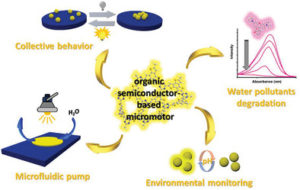 Photosensitive micromotors that can be remotely controlled by visible light irradiation demonstrate great potential in biomedical and environmental applications. To date, a vast number of light‐driven micromotors are mainly composed from costly heavy and precious metal‐containing multicomponent systems, that limit the modularity of chemical and physical properties of these materials. Herein, a highly efficient photocatalytic micromotors based exclusively on a purely organic polymer framework—semiconducting sulfur‐ and nitrogen‐containing donor–acceptor polymer, is presented. Thanks to precisely tuned molecular architecture, this material has the ability to absorb visible light due to a conveniently situated energy gap. In addition, the donor‐acceptor dyads within the polymer backbone ensure efficient photoexcited charge separation. Hence, these polymer‐based micromotors can move in aqueous solutions under visible light illumination via a self‐diffusiophoresis mechanism. Moreover, these micromachines can degrade toxic organic pollutants and respond to an increase in acidity of aqueous environments by instantaneous colour change. The combination of autonomous motility and intrinsic fluorescence enables these organic micromotors to be used as colorimetric and optical sensors for monitoring of the environmental aqueous acidity. The current findings open new pathways toward the design of organic polymer‐based micromotors with tuneable band gap architecture for fabrication of self‐propelled microsensors for environmental control and remediation applications.

The Patent “Anode und Verfahren zu ihrer Herstellung” (Anode and process for its manufacture) has been granted as DE: 10 2019 110 450 and IPC: H01M 4/137 – we’re looking forward to develop this technology together with our partner Inuru GmbH.
Maximum capacities at the theoretical limit come from Adlershof

On April 27, the European Research Council (ERC) announces the recipients of the Proof of Concept (PoC) Grant scheme: one of them is Michael J. Bojdys, materials chemist and junior research group leader at IRIS Adlershof and the department of chemistry of Humboldt-Universität zu Berlin. This makes Bojdys one of the first two ERC PoC grantees in Berlin since the grant was established in 2018. This year’s second recipient is from the TU Berlin.
Proof of Concept Grants are exclusively awarded to researchers who already hold an ERC Grant and wish to move the output of their research towards the initial steps of pre-commercialisation.
In the course of his ERC PoC Grant “Ultra-high energy storage Li-anode materials” (LiAnMAT) Michael Bojdys will develop together with VARTA Micro Innovation GmbH and the Adlershof start-up INURU GmbH, Li anode materials for high capacity applications. First promising results are part of a patent application of HU Berlin and the start-up incubator Humboldt Innovation GmbH: the capacity of the novel anodes exceeds that of commercially available anodes by a factor of 10-40.